The History of Tattooing
Tattooing has been practiced for thousands of years. Explore the history of tattoos, from ancient Egypt and Otzi the Iceman to the first electric tattoo machine.
By Vegan Tattoo Studios · Updated
Embellishing the skin with permanent tattoos is an ancient practice that can be traced back thousands of years across many cultures of the ancient world. Throughout history, people have adorned their skin to mark social status, perform religious rites, beautify themselves, ward off harm, gain magical powers, heal illness, or relieve pain. Body art was — and in many places still is — used in initiation rites, to mark coming of age, and to commemorate life’s milestones.
The oldest known tattoos
The oldest known tattoos date back to the 4th millennium BC. For a long time, the earliest examples in recorded history were Egyptian mummies from the era of the great pyramids — arguably the owners of the most durable tattoos ever made.
Then came Ötzi. Discovered in 1991 by a pair of German hikers in the Ötztal Alps, near the border between Austria and Italy, the “Iceman” is the oldest intact human body ever found. Mummified by the ebb and flow of glacial ice, he died around 3,300 BC — and in the decades since his discovery he has provided a treasure trove of information about Stone Age life.
Researchers eventually finished mapping his body art: 61 tattoos in total. The task proved tricky, since millennia had darkened his skin and hidden the marks from the naked eye, so the team used multispectral photographic imaging to reveal them without damaging the body. The tattoos consist mostly of parallel lines and crosses, likely made by rubbing charcoal into deliberate cuts.
How tattooing spread across the ancient world
As the Egyptians expanded their empire, the art of tattooing traveled with them. The civilizations of Crete, Greece, Persia, and Arabia picked up the art form and developed it further, and around 2000 BC tattooing spread to China.
The Greeks used tattoos for communication among spies — the markings identified them and indicated rank. The Romans marked criminals and slaves. The Ainu people used tattooing to show social status: girls coming of age were marked to announce their place in society, as were married women. The Ainu are credited with introducing tattoos to Japan, where the practice developed into a religious and ceremonial rite.
In Borneo, women were the tattooists. They produced designs indicating the wearer’s station in life and tribe. Kayan women wore delicate arm tattoos that looked like lace gloves; Dayak warriors who had taken a head in battle had tattoos on their hands, which garnered respect and assured their status for life. The Polynesians developed tattoos to mark tribal community, family, and rank, and carried their art to New Zealand, where the Māori developed the facial style called moko — still in use today. There is evidence the Maya, Inca, and Aztec used tattooing in their rituals, and even isolated tribes in Alaska practiced it, in a style suggesting it was learned from the Ainu.
Tattooing in Japan
While tattooing declined in the West, it thrived in Japan — though at first, tattoos there were used to mark criminals. A first offense was marked with a line across the forehead, a second with an arch, a third with another line, the marks together forming the Japanese character for “dog.” It appears to have been the original three-strikes law.
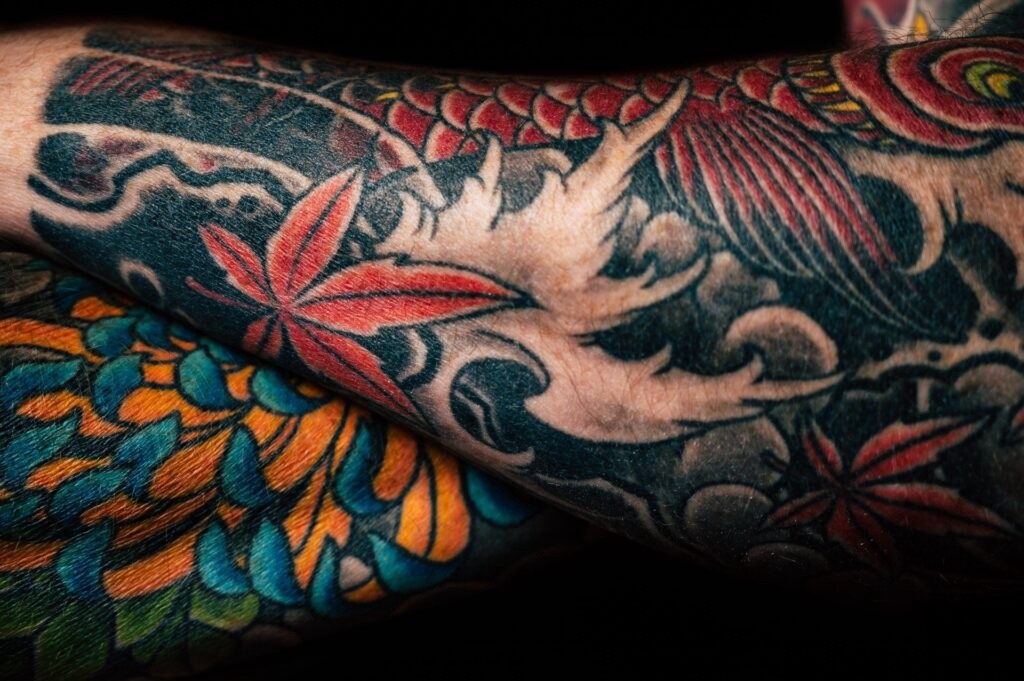
In time the Japanese transformed the tattoo into a high art form. The Japanese bodysuit originated around 1700 as a reaction to sumptuary laws: only royalty were permitted ornate clothing, so the merchant class adorned themselves with elaborate full-body tattoos instead. A heavily tattooed person wearing only a loincloth was considered exceptionally well dressed — but only in the privacy of their own home.
Tattoos return to the West
William Dampier reintroduced tattooing to the West. A sailor and explorer of the South Seas, he brought a heavily tattooed Polynesian man known as Prince Giolo — the “Painted Prince” — to London in 1691, where he was put on exhibition and became the rage of the city. It had been 600 years since tattoos had been seen in Europe, and it would be another century before tattooing took hold in the West.
Captain James Cook gets most of the credit for that. In 1769, the transit of Venus across the sun was due, and the best place to observe it was Tahiti — so the British Navy sent Cook. The expedition arrived months ahead of the event, and the crew spent that time describing Tahiti as a paradise on Earth: beautiful coastline, beautiful climate, and beautiful, colorfully decorated people. Crew members described men covered in drawings of humans and animals — mostly birds and dogs — while the women typically wore a Z-shaped mark on every joint, and both sexes wore other designs such as concentric circles.
Before Cook returned from Tahiti, European languages had no real word for the practice. The word came from the Polynesian tau-tau, an onomatopoeia for the sound of the comb-shaped tattooing instrument being tapped into the skin. Cook recorded it as “tattaow,” then “tattaowing,” and the word quickly spread into every European language: tattoo, tatouage, tatuaggio, tatuaje. Cook also brought home a tattooed Polynesian man named Omai, whose overnight celebrity sparked a short-lived tattoo fad among upper-class Londoners.
The first electric tattoo machine
What kept tattooing from spreading further was the slow, painstaking procedure: every puncture of the skin was made by hand. That changed in 1891, when Samuel O’Reilly patented the first electric tattoo machine, based on an earlier Thomas Edison patent for an engraving device that punched through documents to make copies.
O’Reilly’s machine used an electric motor and rotating crankshaft to raise and lower the needle, making tattoos fast, affordable, and widely available. And as the average person could suddenly get a tattoo, the upper classes turned away from it.
For most of the following century, tattooing’s reputation was poor enough that the craft went underground. Few were accepted into the closed society of artists; there were no schools, no magazines, no associations, and suppliers rarely advertised. You learned through word of mouth where to go and who to see for quality work.
The rise of American tattooing
The birthplace of the American-style tattoo was Chatham Square in New York City — at the turn of the century a seaport and entertainment district full of working-class people with money to spend. Samuel O’Reilly came down from Boston and set up shop there, taking on an apprentice named Charlie Wagner. After O’Reilly’s death in 1908, Wagner opened a supply business with Lew Alberts, a trained wallpaper designer who transferred those skills to tattooing and redesigned a large portion of early flash art.
While tattooing declined elsewhere in the country, Chatham Square flourished. Tattooists inked their wives with examples of their best work, turning them into walking advertisements. Cosmetic tattooing became popular in the same era — blushed cheeks, colored lips, eyeliner. With World War I, flash imagery shifted to icons of bravery and wartime.
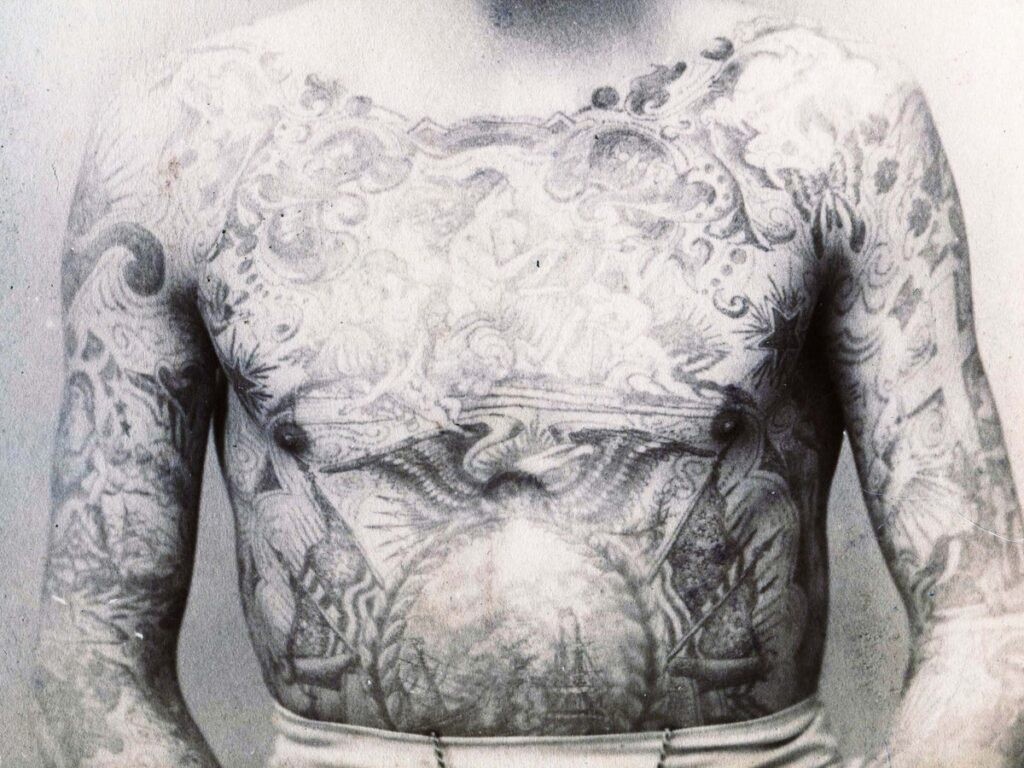
In the 1920s, Prohibition and then the Depression drained Chatham Square of its appeal, and the center of tattoo art moved to Coney Island. Across the country, tattooists opened shops wherever the clientele could support them — above all in cities near military bases, particularly naval ones. Tattoos became known as travel markers: you could tell where a sailor had been by the ink he carried.
After World War II, tattoos were further stigmatized by their association with bikers and juvenile delinquents. Then, in 1961, an outbreak of hepatitis sent the craft reeling. Though most shops had sterilization equipment, few used it, and newspapers filled with stories of blood poisoning and disease. New York City gave tattooists the chance to organize and self-regulate, but they couldn’t manage it; a health-code ban followed, shutting the shops at Times Square and Coney Island. For years it was difficult to get a tattoo in New York at all, and the better shops moved to Philadelphia and New Jersey, where the trade remained legal.
The modern tattoo revival
In the late 1960s attitudes began to change, and much of the credit goes to Lyle Tuttle, the “father of modern tattooing.” He tattooed celebrities — particularly women — and when magazines and television wanted to understand this ancient art form, Tuttle was who they called.
A string of rock stars passed through his San Francisco shop in those years, among them Janis Joplin, whom Tuttle remembered as the “crazy gal with her hair and bracelets on.” She came in for a bracelet tattoo and a tiny heart on her breast, was photographed with the new ink showing, and Tuttle and his peers were promptly flooded with women asking for “the Janis tattoo.” That one meeting made Tuttle a household name — right around the time tattooing was outlawed in New York City, and just as the women’s liberation movement was first making waves in America.
Tattooing today
Today tattooing is more popular and more accepted than it has ever been. People of every background seek out the best artists, and the craft has earned the tattooist a level of respect not seen in over a century — the category of fine artist. Contemporary artists combine the tradition of tattooing with personal style to create unique, phenomenal body art, and with modern inks — including a growing range of vegan ones — the art form has reached a new plateau.
Curious about modern styles? Explore our guide to tattoo styles and techniques, or read 16 surprising tattoo facts.